Friday the 18th of May two worlds collided in TEA and Black Coffee, by the way of Melbourne's Odessa CreativeSpace for RMIT University's faculty of Architecture and Design.
TEA filled the role of musical innkeeper/mood-maker for pop up restaurant, come conceptual art installation KITSCHÉ. A student venture offering diners a "temporary social platform, facilitating an immersive eating and design experience at an intimate scale.”
A five course degustation accompanied by a selection of fine wines, storms in a coffee cup and a choosing of aural afflictions to compliment the KITSCHÉ dining experience - “food and wine through creativity and design,” pleasantly ensued.
Local coffee bean Mark Free of Black Coffee Shop, presented KITSCHÉ the alternative to short macchiatos, flat whites and soy latte after dinner pep-ups, through his “ever evolving experiment” in contemporary filtered coffee.
To my delight coffee and tea drinkers can now unite over the one brew, the delightful Cascara, dried fruit of the coffee "cherry".
Brewed much like tea i.e. filtered through a tea pot, French press or even a chemex, it’s the light coffee alternative for the knock’em back short black folk, or a ride on the wild side for the au courant tea drinker.
So as my warm and fuzzy, caffeine induced high kicked in from sipping back on my newly discovered Cascara, I fired up KITSCHÉ’s SL-1200’s to compliment the visionary and gustatory delights on show.
Patrons were ushered into KITSCHÉ’s heliotrope wonderland soundtracked by the deep and beatless riddums of Quantec’s “Unusual Signals”, Conforce’s "Vacuum" and Luke Hess subtleties. Eduardo De La Calle’s masterful reworking of Miles Davis’ “Flamenco Sketches”, Bocca Grande and French sweetheart Jane Birkin accompanied KITSCHÉ’s initial courses and as el vino flowed, so did the music in Gil Scott Heron, Brian Jackson, Tony Allen and Donna Summer, R.I.P.
With only sweets and wine to finish, a selection of deep house and oddball cuts from Sven Weisemann, STL, Jitterbug, Floating Points and Jean Michelle Jarre rounded out what was a cerebral sensation for the senses.
Pic Credit - Mark Free Pic Credit - Hannah Moriaty
Hardcore and gabba soundtracked Jorn Kerschot’s early teens, a sentiment echoed by the legions of ‘90s Dutch and Belgian ravers. But before the beat happy hordes of hardcore and gabba managed to muster up an army the same way trance did, most by default had jettisoned out and away from its speedy cheesiness - and to its credit both genres remained underground. Dressed in gas masks, oversized pants and fluffy backpacks, hardcore and gabba can be seen as a laughing stock of electronic music. However, both share many of the sonic characteristics heard in today’s popular “dance music” or EDM (Electronic Dance Music).
Genres come and go, but it’s the framework of these genres which remain. Nowadays, who is taken seriously when using the word “dubstep” or “minimal” when explaining a genre of music they enjoy? What genres are next in line? Google ‘techno’ for example and you are instantly inundated with psychedelia, CAPITAL LETTERS, track names featuring the words “Bass Heaven” - and funnily enough the Melbourne Techno Collective. No genre is safe. The internet has been an influential and contributing factor in desecrating mainstays of electronic music, so previous to discovering new trends and genres at the click of a button; hardcore, gabba and EDM - for the curious ones - offers a gateway to bigger and better things.
Hardcore and gabba has played a role in defining electronic dance music, even outside of Belgium and Holland. During my pre-teens a friend’s older brother owned a "Terror Traxx" compilation. I distinctly remember Bodylotion’s “Fuck Martina” and The Forze DJ Team’s “Sweat On My Balls”. Both were epic for a 5th grader and blew my mind. In a recent interview with TEA, Grounded Theory proprietor and K209 collaborator Henning Baer recounts taping his sister’s, boyfriend’s copy of the Rotterdam Termination Source “Merry X-Mess”. The same Henning Baer who recently remixed Justin Berkovi’s “Old Timer” released on Jorn Kerschot’s Other Heights. This is just two of the countless examples of how hardcore and gabba earned their place in electronic music folklore.
Kerschot was lucky in the fact he had an uncle who worked for the legendary Belgian imprint R & S, as well as distributors Pias (Play It Again Sam) - who have worked with everyone from Goldfrapp and Sigur Rós, to the Chemical Brother and Ferry Corsten. Kerschot admits he owes a lot to his uncle, who would covertly plant copies of Drexciya, Moodymann and Chain Reaction to Kerschot orders of Thunderdome (still going to this day and between 2004 - 2008 was released on Universal). Some of Thunderdome’s early ‘90s titles included F*ck Mellow This Is Hardcore From Hell, The Killing Playgroundand From Hell To Earth. Power and energy is often the key to teenage a soundtrack, whether it be the guitar slashing’s of Steve Jones, chainsaw power chords of Bob Rifo’s The Bloody Beetroots, or the screeching break downs of Skrillex, power is what kids want.
Although it was still a bit experimental and down tempo for the teenage Kerschot, his uncle’s sprinkling of cultured sounds slowly made its mark on the Thunderdome obsessed youth. Jorn Kerschot found himself making a transition to a “more straight edge and harder techno,” but on reflection; admits it was was not exactly what he was looking for, but a phase in between. With his teen years almost behind him, Kerschot’s maturing palette lead him to the equally visceral sounds of Surgeon, Ben Sims, Luke Slater and Green Velvet. But it was the cultured and evolved nature of the aforementioned that finally secured Kerschot’s undivided attention.
Kerschot later received another package from his uncle, which included a mixtape from Dutch dub techno producer Mohlao. Kerschot was instantly drawn to it and knew he wanted to work with this kind of music. A student budget at the time meant starting a label was far from reality, but its theoretical seeds were sewn. After completing his studies Kerschot celebrated the launch of his own CDR imprint Other Heights, by entrusting its debut opus with another Dutch dub techno producer Ohrwert and his “Tenth” lp - limited to 100 hand numbered copies. Ohrwert then featured on Other Heights second release, a various artist compilation “Variations In Height”, which housed a combination of dub techno and ambient artists. This same release also featured Kerschot’s muse Mohlao, with his electro and Detroit tinged “Anektode”. Other Heights first three releases, all CDRs, were limited to no more than 100 copies. The first of many including hand drawn pictures or photos from young contributing artists he knew, or sourced from the internet. Kerschot admits when he first launched Other Heights he wasn’t as familiar with techno as many of his contemporaries were “I was only really familiar with older techno like Basic Channel and Chain Reaction, as well as some other smaller labels. I had a specific focus on dub techno.”
Wary of his then blooming dub techno knowledge, Kerschot was cautious when introducing his label “I decided to release on CDs at first because I felt he music on Other Heights was designed for CD. If I was to have released Ohrwert’s Tenth or Alteria Percepsyne’s Cloaks Of Perception on vinyl, it would have been too risky at that time. I also tried to approach it from the listening side rather than the danceable side - Listening for CD, dancing for vinyl.” As the label developed so did Kerschot’s confidence “I consider some of the Ghostek ep to be listening, even though I released it on vinyl. Once Other Heights started growing and evolving as a label, I felt more confident to release tracks like that on vinyl.”
The first to contribute an album to Other Heights was local Belgian and philosophy graduate Herbstlaub. His deep seated “Per Sonare”. “Auf Einen Stern Zugehen, Nur Dieses” and “If Your Afraid Don’t Let Go” are the best examples of Herbstlaub’s beautifully blue and self expressive style, sharing similarities to the dysphoric textures of Moderat and the snow covered percussion of Pantha Du Prince. One of Other Heights more intriguing artists is Emily Griffiths aka Alteria Percepsyne, from Oxford in the UK. Griffiths has so far released two stand alone albums; “Intangible Flutter” on Canadian imprint Silent Season and the breath taking “Cloaks Of Perception” on Other Heights. Kerschot believes Griffiths’ Cloaks Of Perception achieved a lot in connecting people with his label - take one listen to Neverending Spiral, Alone In the Valley or Unfamiliar Glare and you will understand why.
Other Heights first vinyl release came as a 3 track various artists sampler, featuring; Szare, the mysterious Bristolian talent behind the 19.26.1.18.5 releases on Horizontal Ground, Brooks Mosher with his “Dim The Lights”, a track Kerschot heard in a mix by Fanon Flowers, spurring him to email the Detroit legend to find out what the track was, (Mosher has since released on Steffi’s Dolly) and the upcoming American talent Helix, supplying a looped up cut “Pavement”. Soundcloud plays a influential role in Kerschot discovering new talent for his label “I got in touch with Szare after hearing his tracks on Soundcloud and asked if they were still available to be released. He reserved 4th Street Jam and Indo Greek for the first two records.” Through this connection, Kerschot was put in touch with Berlin’s Dubplates and Mastering, an attributing factor Kershot says for the pronunciation of Szares booming kicks, sharp percussion and heaving bass. Szare has since gone on to release again for Horizontal Ground as well as Syndrome Z, Idle Hands and Espen Lauritzens’ Krill Music. Szare’s second release for Other Heights “Indo Greek” was later remixed by Finnish techno don Samuli Kemppi.
Since the labels inception in 2010, it has covered a wide range of sounds and styles, somewhat skewed toward the deeper end of house and techno. Kershot believes a contributing factor to this is an association with the artists he admires and the connections he makes as a result. Kerschot grants that through Szare, he was exposed to the vibrant Bristol scene - resulting in a Kowton release on Other Heights fourth 12”, alongside Mohlao and Mi-24, Conforce’s helicopter gunship alias. Through discovering new movements in music Kerschot felt more confident in releasing more of his own. “I believe people get bored of listening and playing only one style after a while. You can run a label that sticks to specific style for 10 years in order to stay safe and earn money, but by doing that you don’t give artists the chance to express themselves in other ways on your label, it doesn’t give artists a chance to develop. I try and keep myself and Other Heights as open minded as possible”
“I regularly scan Soundcloud and find myself going through many artist pages” says Kerschot when leading in to how he discovered the Burial-esque sounds of Ghostek and then incognito Russian producer, Unbroken Dub - who recently remixed Basic Soul Unit’s“Northern Heights” ep on Other Heights. “I knew Unbroken Dub before he released his Rawax series. His tracks are great, but at that time I wanted to do something else with him rather than release and ep of his own. I wanted some kind of collaboration and that came along the with the Basic Soul Unit ep. I got him to remix both tracks. I think a lot of people made the connection between Unbroken Dub and Basic Soul Unit. I am a big raw house and techno fan, so it was great to get Basic Soul Unit on board”. Kerschot doesn’t go as far to say Other Heights output is timeless, but he does maintain Other Heights is not a throw away label and hopefully will still be enjoyed on a contemporary level in the years to come.
In August of last year Other Heights launched its sub label Moody Heights. As the name suggests it focuses on being a moodier and deeper offshoot to Other Heights. Basic Soul Unit’s Northern Heights ep was due for a release on Moody Heights, but after some deliberation Kerschot centred his energies toward Other Heights, as the label had grown more than he expected and in turn developed a broader palate. Other Heights is currently enjoying the most exposure it has ever received, therefore, for the time being, Daniela La Luz’s “People Happy (The Essential Voyage)” will remain the only Moody Heights release. “I also found Daniela through Soundcloud, she has a nice sound. Her track ‘People Happy (The Essential Voyage)’ contains an interview which is a part of the track, I really liked the voice. There was a personal connection with that track, that is something I really appreciate having with artists. Since then she has also become a friend. If I was do another release with Daniela it would be on Other Heights...There is a place for Moody Heights in the future.”
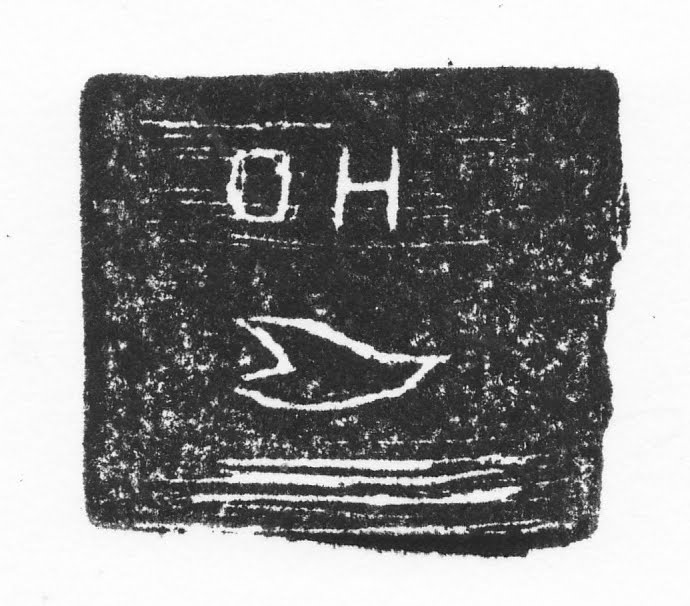
The artwork associated with Other Heights is what makes the label a personal one for the artists involved, with an added Belgian touch. “I make contact with painters and photographers that I know will connect their work, with the music. Daniela La Luz’s girlfriend did all the artwork for the fourth, fifth, seventh and eighth vinyl records. I buy stamps, print them on to paper, scan it and send them to Riet.” say Kerschot. The stamped artwork now typifies Other Heights aesthetic “I search for traditional stamps to correspond with the music. I found a Horse Shoe Crab to represent the aquatic sounds of the Mohlao/Mi-24/Kowton release, as well as a nautical map to represent Basic Soul Unit’s Northern Heights ep”. Kerschot then regals the sometimes troublesome nature of running a DIY label “Hand stamping became problematic as I had 300 records in my living room stamped with ink that would take way too long to dry, especially when they needed to be sent out for distribution ”.
Kerschot may still think his knowledge of electronic music is still at an adolescent stage, but there is no denying that he has his finger on the pulse and a apparent penchant for taking successful risks on obscure talent, plucked from nowhere, or more likely Soundcloud. Take for example; the recently canvassed Ozka, who has gone on to release for James Kumo’s [K:Music] and Myles Sergé’s RE(FORM), or the aforementioned Brooks Mosher and Helix who saw a second release on Night Slugs. But most interestingly if it weren’t for Kerschot’s techno savvy uncle, he may never have learnt of Mohlao, a name in dub techno that should be shouted from all of The Netherlands windmills. Mohlao is a well on his way to enjoying the same positive commentary associated with Conforce, Delta Funktionen and Joroen Search. Under his Multicast Dynamics moniker, Mohlao contributed two tracks to Dutch label Field Recordings as well as teaming up with Delta Funktionen for their Inward Content project on Meanwhile - a label housing music from Sven Weisemann, Quantec, Conforce and or course Murmur. Kerschot confirms more of Mohlao’s scuffled dubs are in the works for Other Heights.
At the moment Other Heights is rising faster than Kerschot probably realises. Having shed light on previously uncelebrated talents such as Brooks Mosher, Ghostek, Cairo & Svpreme, Ozkar and Jakob Altmann as well as securing services from Samuli Kemppi, Justin Berkovi, Conforce, Basic Soul Unit and Henning Baer - Kerschot’s dub techno and house piloted venture, is well on its way to reaching a lofty apex shared by an esteemed clutch of Belgian labels; Music Man, R&S, Time To Express, Token and Curle. Not bad for a Thunderdome kid.
Dutch producer and Other Heights artist Metropolis, aka Nick Lapien recorded this podcast for TEA. Lapien recently released his "Anvers" ep on Bliq Records which featured remixes from Fred P and the reliable Conforce. Lapien is also a part of the "Distant Drummers Collective". His "Guardian Of The Heartmachine" ep as Metropolis is forthcoming on Other Heights.
Tracklist
Jim Morrison on the future of popular music
Lapien - Anvers (Conforce Remix) [Bliq]
Lapien - Maybe (Deep Edit) [Unreleased]
Nina Kraviz- Voices (Fred P Reshape) [Underground Quality]
Dutch sea-sider Boris Bunnik akaConforce can very rarely undertake an interview without the mention of this mystical mixtape his father found in the Terschelling woods. Had this tape contained some early Bill Monroe or Kenny Dorham rather than the acid house or early rave would Boris Bunnik now find himself flat picking a guitar in a bluegrass trio or flutter tonguing his trumpet in a bebop big band? For the electronic music lover this is something that thankfully never happened.
So who is to thank for the rise of Conforce? Bunnik senior? The mysterious mixtape? Perhaps the Terschiling Dance Cafe? Who knows, but since his breakthrough 2007 Our Concern EP on local and legendary imprint Rush Hour, Bunnik's steady flow of acid jackings and electro grooves under an array of monikers including Versalife and Vernon Felicty have helped soundtrack many of the worlds dancefloors as well as put Terschelling on the map.
TEA caught up with Conforce prior to his fabric debut this friday for a quick email interview on Joey Beltram, audio visuals, Lipton Andalusia pyramids and the announcement of a new Conforce LP.
Tell us a little about Terschelling. I read that the island is known for its cranberries and is also surrounded by shipwrecks. What was it like growing up there?
In a nutshell it's a great place to grow up, it's safe, healthy, wide and it has a diverse bio climate. In a way it is the ultimate mini utopia where you can really be yourself. The only point of criticism I have is that the level of social control is very high which can make you feel very oppressed. When it comes to creative and inspiring influences on an electronic music level there weren't very many. Also if you look at education and self expression in artistic ways, there just aren't that many possibilities, it's very limited when you reach a certain age. I still go back a lot to recharge my batteries as I enjoy the great outdoors and visiting my family.
This tape your father found looks to have played quite an influential role in your life. Can you remember any specific tracks that were on that tape?
I don't really remember any specific titles but believe me it was acid and early rave. Joey Beltram was on it for sure.
How important was your time at the Dance Cafe in Terschelling?
That was actually my first platform to play music to an audience, so I had the opportunity to learn a lot at the Dance Cafe. I think it gave me a self-confidence to really play music for a crowd. It was there that I was first put in touch with various styles of music, mainly house. This naturally lent itself to me discovering more of the styles I now love. The owner was pretty much the first person who introduced me to studio hardware and home made productions.
Your studies have also landed you work as an audiovisual designer?
During my academic studies I focussed on documentaries, mainly human interest but some of my work had an anthropological approach. I think journalistic qualities are an important aspect of making these films. Society in its widest sense is something that will always fascinate me. Making documentaries meant I was able able to show my vision on sociological aspects of society, this involved other countries but also that of my own environment. Video production can be a very time-consuming business, once a documentary is realised much of the effort behind it is not. Nowadays I am doing some commercial work as well as combining film with electronic music.
You mention there are many parallels in photography and music. I’ve noticed much of your photography is of buildings, urban landscapes and structures. Is this your how you correlate your music with your other work?
Since I'm from an island I've noticed that I have a contemplative way of walking through urban environments, I do get a lot of inspiration from that. I think there is a certain eye for detail in my photographs which involve dynamics, layers and hard contrasts. I'm not sure if it is always that present in the music but I find each deliver inspiration to each other. It's both a pure self reflection and vision of what I really like, brining both mediums together is fantastic.
How did the concept of Versalife come about and how big of a role has electro played in your musical upbringing?
Actually electro is something that never came about my path in my early years of DJing, it's really something that has happened over the last 4 years, it spread like a virus (laughs). I found I was able to work out my feelings and ideas through electro's rhythm sections, more so than a 4/4 orientated structure. I find there is more space for interesting melodic elements and story telling in electro which makes me feel more in theme and allows for a different approach to layering. It has helped me to work conceptualise music ideas that give more space to the listeners imagination. I just wanted to experience how it was to limit yourself to real synthesizers and drum machines.
You mention with Versalife that you worked with 4 machines only. Is this a less is more approach?
Even with one synth you can be as creative as you want. I wanted to create more of a signature sound of my own, I found a good way of doing this is to get inside your machine and push it to the limit. This helped me to focus and led to more creativity as my options were restricted.
Tell us about your machine conspiracy concept of connecting your soul to a machine?
For me it's really about feeling the music and letting your intuition lead you towards something cool. Something that translates your mood and your soul into the music, something where you find yourself saying "what happened here?". Let the machines work for you and not the other way around.
Do you think this is something that can be lost producing music with digital software?
I'm not one to say that hardware is better than software as both have good and bad aspects, combining the two is great. For me, hardware helped me develop a stronger signature sound, it's totally different feeling and practice when you spend 500 euros on a synthesizer you really want as opposed to downloading 20 illegal vst plugins that all have a similar clinical digital sound. I've learned that hardware bass can not be bettered by a software bass, it's something totally different. Having said that using other digital sounds on top of hardware sounds works really well.
You are playing Room 2 at fabric on the 25th. How often do you get to play in London and how have you found it?
Yeah it's my first time at fabric. I played once before in London at Corsica Studios and that was amazing! I have also played in Bristol which was awesome too. I get a lot of appreciation from the audiences in the UK and I really love the people, I've never had a disappointing gig here, people really love the bass (laughs). I am really looking forward to playing at fabric, it is such an honor to play at such a historically long running club.
How did the idea of creating a live show first come about and how far have you seen it progress from where it first started?
It's something that I think grows with your production skills. I think the most important thing over the years is that it has become dancier as well as functional. I think this has resulted in the impact it gives to audiences.
I’ve noticed many of your releases are on Dutch labels. How tight knit is the Dutch scene and how much do you feel apart of the sound coming out of the Netherlands?
I'm just one of a few who is just doing there thing. I am very happy that I got in contact with those labels and that they saw some potential in my music. This gave me an opportunity to grow as an artist and develop my sound.
Do you have a follow up LP in the works?
Yes. I finished my new album last week. It's entitled "Escapism" and it will be released on Delsin around August or September this year.
What is next for Boris Bunnik, Conforce and Versalife?
A big chilled holiday and some gardening activities during the summer. I have some remixes coming up on Dolly, Echocord, Seventh Sign, Coincidence and some other releases on Abstract Forms, Clone and Delsin.